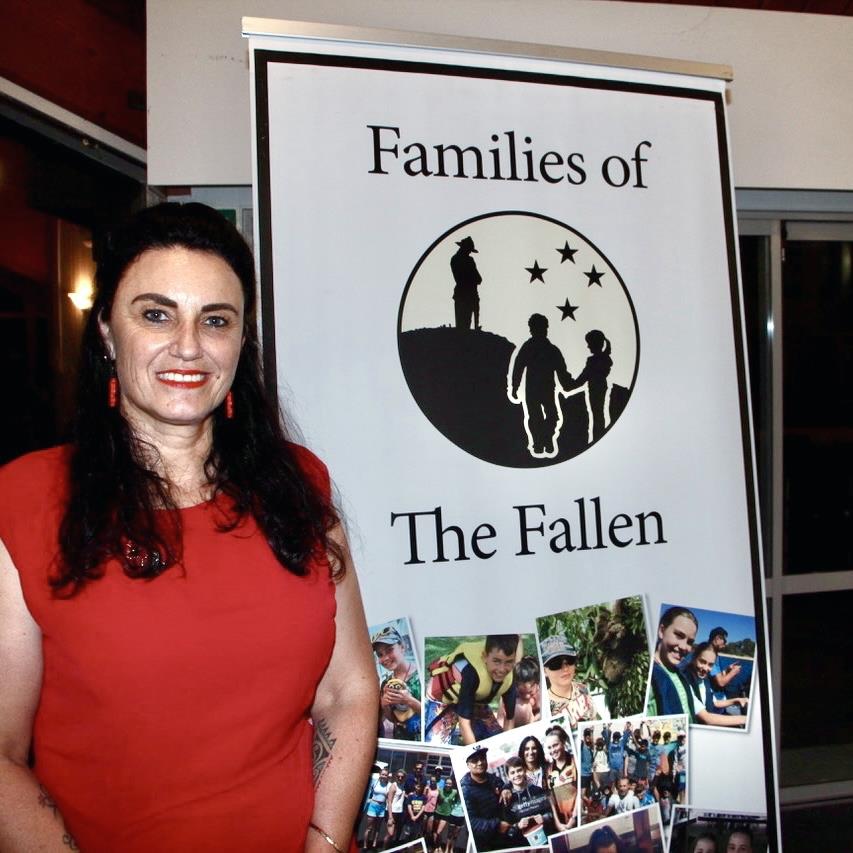
 Tina is a JP, a trained teacher, and a death doula who accompanies a person (and their family/whānau) as they transition out of their life (also known as a Death Midwife or Deathwalker). She joined the meeting to share her journey and how she now serves her community following the death of her husband (Corporal Douglas Grant) in Afghanistan 12 years ago.
Tina talked to members and guests about how she came to her work through grief. She reminded the meeting that everyone’s journey is unique – one loss is never the same as another, and some losses make people stronger/resilient – which has been true for her.
Grief is not a stopping place
In 1990, Tina arrived in Waiouru as an 18-year-old and graduated from there to join the Burnham medical corps in Christchurch. After a period, she was posted in Waiouru for four years before being moved to Linton to 1RNZIR as the first female in that regiment. At 24 years of age, Tina got a regional away post in Bosnia as her first tour of duty where one of her highlights was interacting with the locals. On her return to New Zealand, Tina relocated to Auckland with her Army partner (and subsequently her husband) where she became the first woman to join the SAS and served in this capacity for 11 months.
Tina left the Army to study as a teacher and lived the life of a wife of a soldier, which often involved not knowing when he was going to be about. As a consequence, Tina did most of the upbringing of their two children. When the eldest was ready for school, Tina went back to the Army as an educator and undertook extramural study while raising their children. After 7 years of building in the Army, Tina’s husband wanted more of an adrenaline rush and went to Auckland with the intent that Tina and their children would join him once arrangements had been made.
Tina’s husband was told he was going to Afghanistan shortly after getting to Auckland. Not long after he left, Tina received a phone call late at night, and a knock on the door from the Army padre a tall gentleman who came into the house said they had something to tell her and advised her husband had been killed. He had been shot by a sniper while rescuing three British citizens and two others from a cultural centre in Kabul.
Tina wondered what to do … and put her soldier hat on. She needed to get it together for her kids and to tell her husbands’ family. The Army walked with her through her husband’s repatriation and funeral and helped ensure the basics were in place for her and her children. There were three services to farewell her husband over a couple of days, who recognised all components of his life – a SAS farewell, a huge military funeral, and a private service just for the family.
Tina packed up their house and moved to Auckland to continue with their joint plans, leaving behind her support groups and army friends. She started a new job and was then made redundant by the Army with a finishing date of 13 December, the day her husband was supposed to come home. The Army subsequently apologised and kept Tina on for another seven months. At that time, she bumped into Judith Collins, and they talked about the support Tina received when her husband died and the lack of support that followed. She asked Tina to write down what she thought needed to happen, and through that contact, Tina was asked by the Army to write a job description for the support of people who have lost someone in the Army.
That was in 2012, and it resulted in Tina facilitating, coordinating, and advocating for the 12 families of fallen soldiers. When she is not supporting people one-on-one, Tina is organising weekends for people to come away – meet, greet, cry, and share with others what worked and didn’t work for them. In 2017, Tina was humbled to be awarded the Distinguished Service Decoration.
Over time Tina identified other gaps in support of soldiers and their families and created KIWI - a group for killed, injured, wounded, and ill soldiers. There are around 150 families who need support. When Tina is not supporting families, she educates soldiers on death administration, particularly advanced care plans – the documents you write while you are healthy and well to help your family when you pass away. Soldiers don’t have to have a will; there can be many issues when they die, particularly because they receive Army life insurance of $300k. Tina is trained for end-of-life support, meaning she can walk alongside terminally ill soldiers.
Tina had the opportunity to visit Geneva, where she sat on a panel with other countries to talk about what we do here. During that trip, Tina became unwell and subsequently found she had a brain tumour and a tumour in her abdomen. She felt that if she could survive the loss of her husband, she could survive this, and after 12 months of recovery, is through it.
As years have passed, the list of those lost continues to grow. Tina has formed a Trust (Families of the Fallen Charitable Trust) to continue to support families because the Army can only look after its soldiers. The Trust supports children who have lost parents in uniform to attend camps to connect and share their experiences - this year 90 children attended. The Trust also helps relocate families – so Tina does a lot of fundraising.
At the end of her talk, Tina presented a special coin to President Lyn, which had a solder on one side with hands down at rest, and a boy and girl on the front which are her children, as well as a southern cross least we forget. She advised the meeting that while the Facebook site is restricted to families, members can read more once the website is up online (nearly ready to go)
John Munro thanked Tina for sharing her story and for being an incredible inspiration. John noted how so many people can get weighed down by grief and acknowledged Tina as a great role model for all the families that have gone through the same.